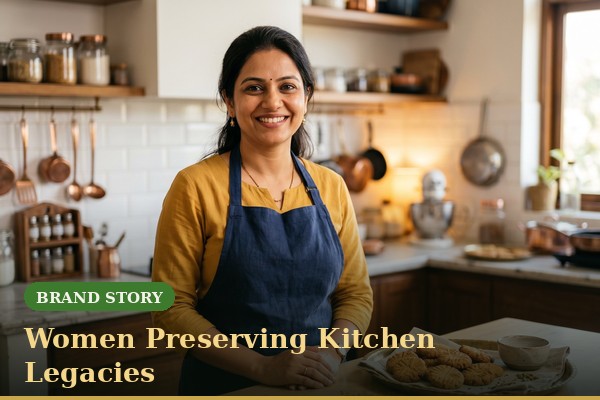
Behind every jar of authentic Thekua lies a deeper story — not just of a recipe, but of a woman who refused to let a precious inheritance fade. The journey of ANORAA is, at its heart, the story of matriarchal kitchen wisdom finding a modern voice. It is about taking the unwritten recipes passed from grandmother to mother to daughter and giving them the professional foundation to reach the world.
The Kitchens That Raised Us
For generations, the most sophisticated food laboratories in India were not laboratories at all — they were home kitchens, presided over by grandmothers and mothers who possessed an intuitive mastery that no degree could confer. They knew exactly when the ghee was hot enough by its shimmer, exactly how much jaggery balanced the wheat, exactly how long to bake or fry by sound and smell alone. This was knowledge encoded not in books but in hands and memory.
The tragedy of modernity is how easily this knowledge slips away. As families shrink, as young people migrate to cities and abroad, as convenience food replaces home cooking, the chain of transmission breaks. A recipe perfected over two hundred years can vanish in a single generation simply because no one wrote it down and no one had time to learn it.
A Founder's Resolve
It is against this loss that founder Amrita Mishra set her work. Deeply inspired by the ancestral culinary wisdom of Indian home kitchens — the timeless legacies of grandmothers, maternal matriarchs, and mothers — she recognised that preserving these recipes required more than nostalgia. It required building a bridge between the old kitchen and the modern marketplace.
That bridge is harder to build than it sounds. A home recipe relies on intuition and small quantities; scaling it demands consistency, hygiene standards, sourcing relationships, packaging that protects freshness, and compliance with food-safety regulations. The challenge was to professionalise the process without sterilising the soul — to keep the homemade character intact while meeting the standards a modern brand requires.
The Particular Path of Women Entrepreneurs
The food-tech and packaged-foods space has not always been welcoming to women founders, despite the irony that the underlying culinary knowledge is overwhelmingly female-inherited. Building a brand means navigating supply chains, manufacturing, regulation, and distribution — domains where women have historically been under-represented and under-supported. Every woman who builds a successful food brand widens the path for those who follow.
There is a poetic justice in women reclaiming, as entrepreneurs, the very culinary heritage that women created as homemakers. The matriarchal kitchen wisdom that was once confined to the home is now becoming the foundation of businesses, intellectual property, and economic independence.
Modern Standards, Ancient Soul
The ANORAA approach reflects this balance. The recipes honour tradition: whole wheat, pure desi ghee, jaggery, the classic aromatics. But the execution embraces modernity: a strict zero-palm-oil policy, no preservatives or artificial colours, dedicated small-batch protocols, food-grade packaging built for transit, and variants — baked, fried, gluten-free, stevia-sweetened — that make the heritage accessible to every modern dietary need.
This is not tradition frozen in amber. It is tradition allowed to grow — to reach a diabetic grandfather through the stevia range, a celiac child through the gluten-free line, a health-conscious professional through the baked version. The matriarchs who created these recipes would, one hopes, be proud to see them adapted so that no one is excluded from the table.
The Larger Mission
Preserving recipes is, in the end, preserving culture. When a young person in a foreign country tastes an authentic Thekua and feels a connection to a homeland they may barely know, a thread of heritage is rewoven. When a recipe that might have died with one generation instead reaches millions, a small victory is won against the homogenising forces of industrial food.
This is the quiet, profound work of women in food-tech: not merely building businesses, but acting as custodians of cultural memory. Every authentic product that reaches a shelf is a refusal to let the wisdom of the kitchens that raised us disappear. It is entrepreneurship as preservation, commerce as cultural service.
An Invitation
To taste ANORAA's Thekua is to participate in this preservation. It is to vote, with your purchase, for a world where heritage recipes survive, where women's culinary knowledge is valued and rewarded, and where the homemade soul of Indian food finds a way into the modern world without compromise. That is a story worth being part of — one delicious, golden bite at a time.
The Invisible Labour of the Home Kitchen
For centuries, the culinary knowledge that sustained Indian families was created and maintained almost entirely by women, yet it was rarely recognised as expertise. The grandmother who could judge the exact moment to remove a sweet from the heat, the mother who knew a recipe's every nuance by heart — their mastery was real and hard-won, but it was invisible, unpaid, and unrecorded. It existed in the domestic sphere, valued emotionally but never economically.
The rise of women food entrepreneurs represents a profound shift: the transformation of this invisible domestic knowledge into recognised, valued, and economically productive expertise. When a woman builds a business on her grandmother's recipes, she is not only preserving those recipes but also finally claiming economic value for generations of uncompensated female culinary labour. This is quietly revolutionary.
The Challenges of Scaling Intuition
One of the hardest problems in heritage food entrepreneurship is converting intuitive, improvisational home cooking into a consistent, scalable process. A grandmother's recipe might call for cooking "until it looks right" or adding sweetener "to taste" — instructions useless for industrial reproduction. Translating this tacit knowledge into precise, repeatable specifications, while preserving the character that made the original special, requires both deep culinary understanding and operational rigour.
This translation is itself a sophisticated skill. It demands someone who understands the food intimately enough to know which elements are essential and which can be standardised, who can codify intuition without killing it. Women founders, often carrying the inherited knowledge directly, are uniquely positioned to perform this delicate translation faithfully.
Navigating a Male-Dominated Industry
The infrastructure of packaged food — manufacturing, supply chains, distribution, retail relationships, regulatory compliance — has historically been a male-dominated domain. Women entering it often face additional barriers: skepticism from suppliers and distributors, difficulty accessing capital, and the persistent challenge of being taken seriously in negotiations. Each woman who succeeds despite these obstacles makes the path slightly easier for those who follow, building networks and proving the viability of women-led food enterprises.
There is a meaningful irony in the fact that an industry built on female-inherited culinary knowledge has been so male-dominated at the entrepreneurial level. The current generation of women founders is correcting this imbalance, reclaiming not just the recipes but the businesses built upon them.
Heritage as Competitive Advantage
Far from being a constraint, authentic heritage knowledge is a powerful competitive advantage in today's market. Consumers increasingly distrust anonymous industrial food and crave authenticity, story, and connection. A brand rooted in genuine family tradition, carrying real inherited recipes and a sincere preservation mission, offers exactly what mass-produced competitors cannot. The grandmother's wisdom that was once economically invisible becomes, in the right hands, a brand's most valuable asset.
This alignment of cultural preservation and commercial viability is encouraging. It means that doing the right thing — honouring tradition, using authentic ingredients, telling true stories — is also good business. The market increasingly rewards authenticity, creating space for heritage brands to thrive on their integrity rather than despite it.
A Model for the Future
The journey of women entrepreneurs preserving culinary heritage offers a model that extends beyond food. It demonstrates how traditional knowledge, often held by marginalised groups, can be honoured, preserved, and made economically sustainable without being exploited or diluted. It shows that modernisation and tradition need not be enemies. And it proves that businesses can be built on the foundation of cultural service, creating value while preserving heritage. For every young woman watching, it offers proof that the knowledge passed down through her family is not just sentimental — it can be the foundation of something lasting and meaningful.