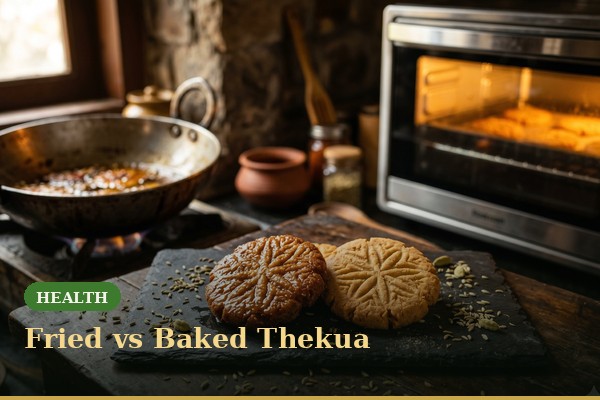
One of the most common questions we receive is delightfully simple: should I choose fried Thekua or baked Thekua? The honest answer is that there is no single correct choice — only the right choice for your particular taste, occasion, and dietary goals. Both versions are authentic, both are delicious, and both have a legitimate claim to tradition. Understanding the difference helps you decide with confidence.
The Case for Traditional Fried Thekua
Fried Thekua is the version most closely associated with the original Chhath Puja preparations. The dough — whole wheat flour bound with jaggery or sugar and a little ghee — is shaped and then deep-fried, traditionally in pure ghee or a clean, heart-friendly oil. Frying produces a distinctive result: a crisp, slightly bubbled exterior giving way to a dense, chewy interior. The flavour is richer and rounder, because frying caramelises the surface sugars and deepens the nutty notes of the wheat.
For many people, fried Thekua is non-negotiable during festivals. It is the taste of childhood, of a grandmother's kitchen, of celebration. There is nothing wrong with enjoying it — the key, as with all rich foods, is the quality of the fat used and the moderation of the portion. ANORAA's fried range is prepared in pure desi ghee and rice bran oil, never palm oil, which makes a meaningful difference to both flavour and health profile.
The Case for Modern Baked Thekua
Baked Thekua is the contemporary reinvention for those who want the heritage taste with a lighter footprint. Instead of submerging the dough in hot fat, it is slow-baked in an oven. This dramatically reduces the total oil absorbed, producing a snack that is lighter on the stomach and lower in overall fat. The crunch is still there — arguably even crisper and cleaner — and the aromatic profile of cardamom, fennel, and ghee remains intact.
Baking suits the everyday snacker, the fitness-conscious, and anyone managing their fat intake. It lets you enjoy Thekua as a regular tea-time companion rather than an occasional festive indulgence. Because baking eliminates the variability of frying, each baked Thekua is also remarkably consistent in texture.
The Palm Oil Problem — And Why We Avoid It Entirely
Whichever version you choose, the single most important factor in a Thekua's healthfulness is the fat used. The market is flooded with cheap, mass-produced sweets fried in palm oil — a highly saturated fat that is inexpensive but linked to poor cardiovascular outcomes when consumed in excess, and whose production carries significant environmental concerns. Many commercial "traditional" snacks rely on it precisely because it is cheap and extends shelf life.
This is where a clean-label commitment matters. By using only pure desi ghee and rice bran oil, the entire fat equation changes. Desi ghee contains fat-soluble vitamins and has been part of the Indian diet for millennia; rice bran oil is prized for its balanced fatty-acid profile and high smoke point. The point is not that fat is bad — it is that the type of fat is everything.
Reading the Nutrition Honestly
It would be dishonest to claim that any Thekua is a "diet food." It is a wholesome treat, and treats contain energy. A fried Thekua will naturally carry more fat than a baked one of the same size. A jaggery version will have a different sugar profile than a stevia-sweetened one. The value of a clean-label brand is not that it makes calories disappear — it is that every calorie comes from a recognisable, wholesome ingredient rather than a synthetic additive or a cheap industrial oil.
This honesty is important. We would rather you enjoy a smaller portion of a genuinely good Thekua than a large portion of something engineered to be cheap. Quality changes the entire relationship you have with a snack.
Which Should You Choose?
Choose fried when you want the full, traditional festive experience — the rich, indulgent version that connects you to the original ritual. Choose baked when you want a lighter, everyday snack you can enjoy more frequently without a second thought. Many of our customers keep both: baked for the daily chai, fried for the special occasion.
There is also the gluten-free range for those with celiac disease or gluten sensitivity, and the stevia-sweetened Lite Delight line for those managing blood sugar. The beauty of modern Thekua is that the tradition has expanded to include everyone, without anyone having to compromise on the essential experience.
The Bottom Line
Fried versus baked is not a battle with a winner. It is a choice between two legitimate expressions of the same beloved snack. What truly matters is what goes into them: whole grains instead of refined flour, real ghee instead of palm oil, natural sweeteners instead of synthetic ones, and absolutely no preservatives or artificial colours. Get those fundamentals right, and whether you fry or bake becomes a happy matter of personal taste rather than a health compromise.
So enjoy the version that brings you joy. Respect the portion, respect the ingredients, and let Thekua be what it has always been — a wholesome celebration in every bite.
A Closer Look at the Baking Process
Baking Thekua is more technically demanding than it appears. Without the immersive, even heat of hot oil, the baker must rely on the dry, radiant heat of an oven to achieve the same internal cooking and surface crispness. This requires careful control of temperature and time. Too hot, and the exterior darkens before the interior sets; too cool, and the Thekua dries out without developing its characteristic crunch. Achieving consistency across a batch is a skill that combines traditional intuition with modern equipment precision.
The reward for this effort is significant. Baking allows the wheat and jaggery flavours to develop through gentle caramelisation rather than the rapid searing of frying. Many people find baked Thekua's flavour cleaner and its texture more uniform. And because no oil is absorbed during cooking — only the small amount of ghee mixed into the dough remains — the total fat content drops considerably.
The Fat Question in Detail
When food is deep-fried, it absorbs a portion of the cooking oil, and the amount depends on factors like temperature, time, and the food's surface area. A dense Thekua absorbs less than an airy fritter, but it still takes on meaningful oil. Baking sidesteps this entirely. The result is that a baked Thekua can contain substantially less total fat than its fried counterpart, even when both use the same wholesome ghee in the dough.
For someone eating Thekua occasionally as a festive treat, this difference may not matter much. For someone enjoying it as a daily tea-time companion, it matters a great deal. Over weeks and months, the cumulative difference in fat intake between a daily baked Thekua and a daily fried one becomes considerable. This is why the baked version is positioned as the everyday choice and the fried version as the indulgent one.
Texture, Mouthfeel, and Personal Preference
Beyond nutrition, the two versions offer genuinely different sensory experiences. Fried Thekua tends to have a richer, denser, sometimes slightly oily mouthfeel — a luxurious quality that many associate with festive food. Baked Thekua is typically lighter and crisper, with a cleaner finish. Neither is objectively superior; they are simply different pleasures, suited to different moods and moments.
This is worth emphasising because the wellness conversation sometimes implies that the "healthy" version is the only acceptable choice. That is joyless and unrealistic. Food is about pleasure as much as nutrition. The honest position is that both versions are legitimate, both can be made with clean ingredients, and the choice between them is a matter of occasion and taste rather than virtue.
Storage and Shelf Life
Both versions share Thekua's traditional advantage: excellent shelf stability without preservatives. Because the recipe contains minimal moisture, properly made Thekua stays fresh for weeks when stored in an airtight container in a cool, dry place. Baked Thekua, with even less residual oil, can be slightly less prone to the rancidity that affects fried foods over very long storage. For both, the enemy is moisture — keep them sealed, and they reward you with lasting crunch.
Making the Choice Your Own
The ideal approach for many households is not to choose at all, but to keep both. Reserve the fried version for festivals, special guests, and moments of genuine indulgence. Keep the baked version as your everyday companion to chai and coffee. Add the gluten-free and stevia-sweetened options for family members with specific needs. In this way, Thekua becomes not a single product but a flexible tradition, adaptable to every member of the family and every occasion of the year. That flexibility, more than any single version, is the true achievement of modern Thekua-making.