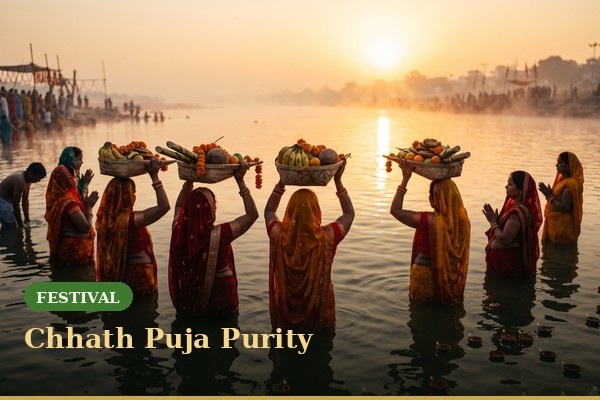
Chhath Puja is unlike any other festival in the Hindu calendar. There are no idols, no temples, no priests mediating between devotee and deity. Instead, there is the devotee, the river, the rising and setting sun, and an offering prepared with a level of purity that borders on the absolute. At the heart of that offering sits Thekua — the Maha-Prasad — and understanding why its preparation is taken so seriously is the first step to honouring the festival properly.
The Meaning of Purity in Chhath
For the four days of Chhath, the observing family enters a state of ritual discipline. The fasting devotee — often the mother of the household — abstains from food and water for long stretches, sometimes more than thirty-six hours. The kitchen where the prasad is made is cleansed completely. Onion and garlic are forbidden. The cook bathes, wears fresh clothes, and prepares the offering in a state of fasting, never tasting the food during preparation, because the prasad must reach the Sun God untouched by human appetite.
This is not superstition; it is a discipline of intention. The idea is that food carrying devotion and discipline is qualitatively different from food made carelessly. Whether or not one shares the spiritual belief, the practical outcome is undeniable — Chhath Thekua is among the most carefully made food in all of Indian tradition.
Translating Sanctity to Scale
When a brand offers to supply Thekua for bulk Chhath orders, it takes on an enormous responsibility. You cannot simply run festival prasad through the same line as everyday biscuits. ANORAA addresses this through dedicated small-batch protocols: separate, deep-cleaned preparation zones reserved for festive orders, careful sourcing of the purest ingredients, and preparation timed and handled to respect the spirit of the occasion.
The raw materials matter enormously. Premium whole wheat flour, pure desi ghee, and — for the traditional version — unrefined jaggery rather than sulphured white sugar. No preservatives, because preservatives have no place in a sacred offering. No artificial colour, because the golden-brown of properly baked or fried Thekua needs no enhancement.
Why Families Trust Sourced Prasad
In an ideal world every family would make their own Thekua. But modern life — apartment kitchens, working parents, elderly relatives unable to stand for hours — means that not everyone can. For these families, a trusted source that respects the protocols is a genuine blessing. It lets them observe the festival fully without compromising on the purity that gives the prasad its meaning.
The key word is trust. A family ordering Thekua for Chhath is not buying a snack; they are entrusting a stranger with a sacred duty. That is why transparency about ingredients, preparation, and protocols is not optional — it is the foundation of the relationship.
The Ingredients of Devotion
Let us look closely at what goes into an authentic Chhath Thekua. Whole wheat flour provides the body and the slow-release energy that sustained fasting devotees. Jaggery, the traditional sweetener, is rich in iron — a meaningful detail when the cook has been fasting. Ghee binds and enriches. Cardamom and fennel lend the unmistakable festive aroma. Dry coconut and occasional dry fruits add texture and a touch of luxury. Every ingredient earns its place; nothing is filler.
Planning Your Festive Order
For those planning bulk orders — whether for family distribution, community bhog, or corporate festive gifting — early planning is essential. Small-batch preparation cannot be rushed, and demand peaks sharply in the days before Chhath. Reaching out well in advance ensures your order receives the unhurried attention it deserves.
Consider too the presentation. Thekua given as festive prasad or gift carries emotional weight; thoughtful, food-grade packaging that protects the crunch during transit shows respect for both the food and the recipient.
Keeping the Tradition Alive
Every Chhath, millions of devotees reaffirm one of humanity's oldest acts of gratitude — thanking the sun, the ultimate source of life and energy. Thekua is the edible expression of that gratitude. By preparing it with care, sourcing it responsibly, and sharing it generously, we keep alive a tradition that has nourished body and spirit for countless generations.
Whether you make your own or order from a source you trust, let your Thekua this Chhath carry the one ingredient that no recipe lists but every devotee knows is essential: intention. That is what transforms flour, jaggery, and ghee into Maha-Prasad.
The Four Days of Chhath
To appreciate the role of Thekua, it helps to understand the structure of the festival it serves. Chhath unfolds over four days, each with its own ritual significance. The first day, Nahay Khay, involves ritual bathing and a pure, simple meal. The second, Kharna, sees the devotee fast all day, breaking it only after sunset with a special offering. The third day culminates in the evening arghya, offerings made to the setting sun while standing in water. The fourth and final day brings the morning arghya to the rising sun, after which the long fast is broken.
Thekua is prepared primarily for the arghya offerings, placed in the bamboo baskets (soop) alongside fruits and other prasad. Its presence is non-negotiable; a Chhath without Thekua is almost unthinkable. This central role is precisely why its preparation is held to such exacting standards.
Why Small Batches Matter
Industrial food production optimises for volume and uniformity, running enormous quantities through continuous processes. This is fundamentally at odds with the spirit of Chhath prasad, which demands attention, care, and ritual cleanliness. Small-batch preparation is the only way to honour these requirements at any scale beyond the individual home.
In a small batch, each step receives human attention. The dough is mixed with care, the moulding done by hand, the baking or frying watched closely. Contamination risks are minimised because the dedicated zone is cleaned thoroughly between batches and reserved exclusively for festive production. This is slower and more expensive than mass production, but it is the only approach consistent with the sanctity of the Maha-Prasad.
Sourcing for Sanctity
The purity of Chhath prasad begins with the purity of its ingredients. This means whole wheat flour from trusted sources, free of adulteration. It means pure desi ghee, never cheap substitutes. For the traditional version, it means unrefined, non-sulphured jaggery rather than chemically treated white sugar. Every ingredient is chosen as if it were going to be offered to the divine — because it is.
This standard of sourcing has a happy side effect: it produces a genuinely superior product even for non-ritual purposes. The same care that makes Thekua worthy of the Sun God also makes it a better snack for everyday enjoyment. Sanctity and quality, it turns out, are close companions.
The Emotional Logic of Trust
When a family cannot make their own Chhath prasad and must source it, they are making a profound act of trust. They are delegating a sacred responsibility to strangers. This is not a transaction like buying ordinary groceries; it is closer to entrusting someone with a family heirloom. Brands that serve this need must understand the weight of that trust and honour it through absolute transparency and uncompromising standards.
This is why communication matters so much around festive orders. Families deserve to know exactly how their prasad is made, with what ingredients, under what conditions. Anything less betrays the trust at the heart of the relationship. The best festive suppliers treat this transparency not as a marketing feature but as a sacred obligation.
Carrying Tradition Forward
Perhaps the deepest value of properly sourced Chhath Thekua is that it allows the festival to continue in circumstances that might otherwise prevent it. An elderly couple in a city apartment, a working family with no time to prepare, a diaspora household far from home — for all of them, access to authentic prasad means the tradition survives another generation. In this sense, supplying genuine Chhath Thekua is not commerce but cultural preservation, ensuring that one of humanity's oldest acts of solar gratitude endures in a changing world.