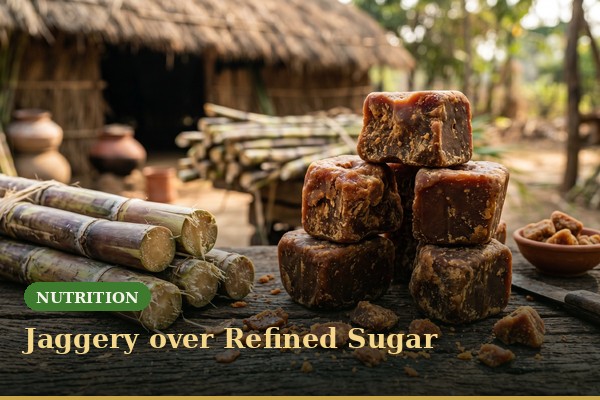
Sweetness is one of humanity's oldest cravings, but not all sweetness is created equal. The difference between refined white sugar and traditional jaggery — known across India as gur — is far greater than colour. It is the difference between an empty source of calories and a sweetener that still carries the minerals of the sugarcane it came from. Understanding that difference reframes how we think about the sweets we love.
What Refining Strips Away
White sugar begins as sugarcane juice, rich in minerals and plant compounds. The industrial refining process boils, clarifies, filters, and crystallises that juice repeatedly, often using chemical agents, until nothing remains but pure sucrose — sweet, white, and nutritionally hollow. Everything that made the original juice nutritionally interesting is discarded as molasses or filtered out entirely. What reaches your table is, in effect, a chemical isolate.
This is why refined sugar is so often described as delivering "empty calories." It provides energy and nothing else — no minerals, no fibre, no plant compounds. Worse, much commercial white sugar is processed with sulphur, leaving traces that clean-label advocates prefer to avoid entirely.
How Jaggery Keeps Its Goodness
Jaggery is made the old way: sugarcane juice is boiled down and allowed to solidify without the aggressive refining and chemical treatment. Because it skips that stripping process, jaggery retains a meaningful portion of the cane's original minerals — notably iron, but also magnesium, potassium, and trace antioxidants. Its characteristic deep amber-to-brown colour is the visible signature of everything that refining would have removed.
The iron content is particularly significant in the Indian context, where iron-deficiency anaemia remains widespread, especially among women. While jaggery is not a substitute for medical treatment of anaemia, choosing it over white sugar means your sweetness comes with a small nutritional bonus rather than none at all.
The Flavour Dimension
Beyond nutrition, jaggery simply tastes more interesting. Where refined sugar delivers a flat, one-note sweetness, jaggery brings depth — caramel, molasses, an almost smoky warmth. In a Heritage Gur Thekua, this complexity transforms the snack. The jaggery does not merely sweeten; it adds a rustic, nostalgic character that white sugar can never replicate. This is the taste that older generations remember from authentic homemade Thekua.
Non-Sulphured and Unrefined: Why It Matters
Not all jaggery is equal. Some commercial jaggery is treated with chemical clarifiers and sulphur to lighten its colour and improve appearance — partially defeating the purpose. Genuinely clean jaggery is non-sulphured and minimally processed, retaining its natural darker colour and full mineral content. When we speak of using premium jaggery in our Heritage Gur range, this distinction is central. The goal is the real thing, not a cosmetically improved imitation.
The Glycemic Conversation
A common question is whether jaggery is "safe" for those watching blood sugar. Honesty matters here: jaggery is still a sugar and does raise blood glucose. It is not a free pass for diabetics, who are better served by the stevia-sweetened Lite Delight range. However, for the general population, jaggery's mineral content and slightly more complex composition make it a more wholesome choice than refined sugar. The presence of trace fibre and minerals means it is not quite the pure glucose bomb that white sugar is.
Tradition Knew Best
It is worth pausing on the fact that traditional Thekua used jaggery not because anyone had measured its iron content, but because jaggery was what was available and what tasted right. Once again, traditional food wisdom arrived at a nutritionally sound choice through experience rather than laboratory analysis. The ancestors who sweetened their festive offerings with gur were, by happy accident or accumulated wisdom, choosing the better sweetener.
Making the Switch
You need not overhaul your entire diet overnight. But choosing jaggery-sweetened treats over refined-sugar ones, where the option exists, is a small upgrade that compounds over time. Every Heritage Gur Thekua you choose over a white-sugar biscuit is a marginally better decision for your body — and a markedly better one for your taste buds. In a world of hollow sweetness, jaggery is a reminder that indulgence and nourishment need not be opposites.
The History of Sugar Refining
The rise of refined white sugar is a relatively recent chapter in human history. For most of the past, sweetness came from honey, fruit, and minimally processed cane products like jaggery. The industrial refining of sugar — producing the pure white crystals we now take for granted — became widespread only in the last few centuries, accelerating with colonial plantation economies. In evolutionary terms, the human body has had very little time to adapt to consuming pure, refined sucrose in the quantities now common.
Jaggery, by contrast, represents the older, more natural way of consuming cane sweetness. Its production predates industrial refining by millennia. When we choose jaggery, we are in a sense choosing the form of sweetness our ancestors actually consumed, rather than the hyper-refined modern isolate.
The Mineral Profile Explained
The minerals retained in jaggery deserve closer attention. Iron is the most celebrated, and for good reason in a country where iron-deficiency anaemia is widespread, particularly among women and children. But jaggery also retains magnesium, which supports muscle and nerve function; potassium, important for blood pressure regulation; and small amounts of antioxidants and other trace compounds. None of these exist in meaningful quantities in refined white sugar, which has been stripped of everything but sucrose.
It is important not to overstate this. Jaggery is not a health supplement, and the mineral quantities, while meaningful relative to white sugar, are modest in absolute terms. The honest claim is simply that jaggery is a less empty source of sweetness than refined sugar — it brings something to the table beyond pure calories, whereas white sugar brings nothing.
Traditional Production Methods
Authentic jaggery is made by crushing sugarcane to extract the juice, then boiling that juice in large open pans until it thickens and can be moulded into blocks as it cools. The skill lies in judging exactly when to stop the boiling and in managing the heat to avoid burning. This traditional process retains the cane's natural goodness precisely because it does not subject the juice to the aggressive chemical clarification and repeated crystallisation of industrial refining.
The non-sulphured distinction is important here. Some commercial jaggery is treated with sulphur compounds to lighten its colour for cosmetic appeal. This partially defeats the purpose of choosing jaggery and introduces a chemical residue that clean-label consumers prefer to avoid. Genuinely premium jaggery retains its natural darker colour, a visible sign of its minimal processing and full mineral content.
Flavour as a Reason in Itself
Even setting aside nutrition, jaggery wins on flavour. Its complex profile — caramel, molasses, earthy warmth — adds genuine character to any preparation. In a Heritage Gur Thekua, the jaggery is not a background sweetener but a defining flavour. It is the taste that older generations recognise as authentic, the flavour that distinguishes a traditional Thekua from a generic sweet biscuit. White sugar's flat, one-dimensional sweetness simply cannot compete with this depth.
A Sensible Perspective
The goal here is not to demonise sugar absolutely or to crown jaggery as a health food. Both are sugars; both raise blood glucose; both should be enjoyed in moderation. The argument is comparative and practical: when you are going to enjoy something sweet anyway, choosing the version made with mineral-retaining, minimally processed, naturally flavourful jaggery is a marginally better and considerably tastier choice than the version made with hollow, chemically refined white sugar. Multiplied across a lifetime of sweet moments, that small upgrade is worth making — and a Heritage Gur Thekua makes it effortless and delicious.