Walk down any snack aisle in India today and you are surrounded by colourful packaging promising taste, energy, and happiness. Flip those packets over, however, and the ingredient lists tell a more complicated story — one written in chemical names, E-numbers, and vague catch-all terms. Learning to read a back-label is one of the most valuable skills a modern Indian household can develop, and it transforms how you shop forever.
The Tyranny of the Unreadable Label
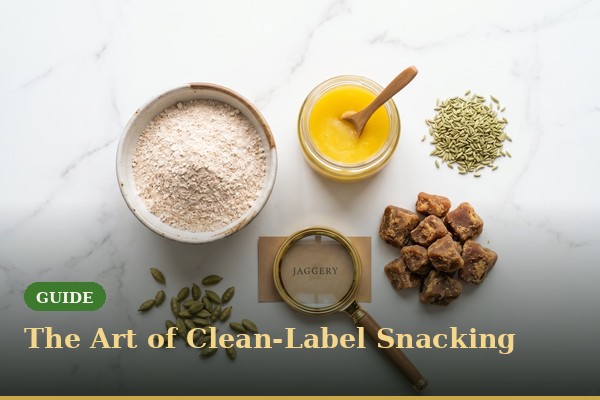
The first rule of clean-label snacking is deceptively simple: if you cannot pronounce or recognise most of the ingredients, be cautious. A wholesome snack should read like a recipe your grandmother might follow — flour, ghee, jaggery, cardamom. When the list instead runs to fifteen items including "permitted emulsifiers," "antioxidant (INS 319)," and "artificial colour," you are no longer looking at food so much as a formulation.
This is not about chemophobia. Many additives are technically safe in regulated quantities. The point is broader: a long list of industrial additives usually signals a product engineered for shelf life and cost rather than nourishment. The additives exist to compensate for cheap base ingredients and to keep the product stable on a shelf for months.
The Usual Suspects
Let us name the most common culprits. Palm oil appears almost universally in cheap snacks — inexpensive, shelf-stable, highly saturated, and environmentally fraught. Refined flour (maida) replaces nutritious whole grains with a fast-digesting, fibre-stripped alternative. Artificial colours make products look more appealing than their ingredients deserve. Synthetic preservatives extend shelf life far beyond what fresh food should have. Hydrogenated fats — the source of harmful trans fats — improve texture and longevity at a real cost to cardiovascular health.
Individually, each is defended as harmless in small amounts. Collectively, a diet built on snacks containing all of them adds up to a genuine health burden, especially for children who consume them regularly.
What "Clean Label" Actually Means
Clean label is not a regulated term, which means brands can stretch it. A genuine clean-label commitment shows up in concrete refusals: no palm oil, no preservatives, no artificial colours, no synthetic sweeteners, no hydrogenated fats. It shows up in positive choices too: whole wheat instead of maida, desi ghee instead of cheap oil, jaggery or stevia instead of refined sugar treated with sulphur.
The test of a clean-label brand is whether the back-label looks like a kitchen ingredient list or a chemistry experiment. With authentic Thekua, the list is short and entirely recognisable. That brevity is itself a kind of honesty.
Decoding Marketing Language
Be alert to language designed to reassure without committing. "Made with real ghee" might mean a tiny fraction of ghee alongside mostly palm oil. "No added MSG" says nothing about the ten other additives present. "Baked, not fried" is meaningless if the product is built on refined flour and synthetic flavour. Always return to the ingredient list itself — it is the only part of the packaging legally bound to tell the truth.
Building Clean Habits
You do not need to become obsessive. Start with a few practical habits. Read the ingredient list before the marketing claims. Favour products with short lists of recognisable ingredients. Be especially careful with snacks intended for children, who eat them often and whose developing bodies are more vulnerable. And support brands that make their standards explicit, because transparency is a sign of confidence in the product.
Over time these habits compound. A household that consistently chooses clean-label snacks reduces its cumulative intake of industrial oils, synthetic additives, and refined carbohydrates dramatically — without anyone feeling deprived, because the alternatives taste better anyway.
Why This Matters More in India
India faces a rising tide of lifestyle diseases — diabetes, heart disease, obesity — increasingly affecting younger people. Snacking patterns are part of the picture. When the default snack is cheap, palm-oil-fried, and refined-flour-based, the long-term public-health cost is enormous. Every household that shifts toward clean-label choices is making a small contribution to reversing that trend, starting at its own table.
The Empowered Consumer
Ultimately, clean-label snacking is about reclaiming agency. For too long, consumers accepted whatever the packaging promised. Learning to read labels turns you from a passive buyer into an informed one — someone who chooses food on the basis of what is actually in it. That shift in power, multiplied across millions of households, is what eventually forces the entire industry to do better. Your back-label literacy is not just self-protection; it is a quiet form of activism.
The Psychology of Packaging
Food packaging is engineered to persuade. Bright colours, appetising photographs, bold health claims, and reassuring buzzwords are all designed to bypass your critical judgement and trigger a purchase. Understanding this is the first step to resisting it. The front of a package is marketing; the back, where the ingredient list lives, is closer to the truth. Training yourself to flip the package over before being swayed by the front is a small habit with large consequences.
Manufacturers know that most consumers never read the ingredient list. This is precisely why so much can be hidden there. The cheerful front promising "wholesome goodness" coexists with a back panel listing palm oil, refined flour, and a string of additives. The disconnect is not accidental; it is a deliberate strategy that relies on consumer inattention.
Understanding Ingredient Order
A crucial detail many shoppers miss: ingredients are listed in descending order of quantity. The first ingredient is the most abundant; the last is present in the smallest amount. This means that a snack listing "whole wheat flour" first is mostly whole wheat, while one listing "refined flour" first and "whole wheat" near the end is mostly refined flour with a token amount of whole grain added for marketing purposes. Reading ingredient order reveals what a product actually is, beneath its claims.
Apply this to sweeteners and fats too. If sugar or palm oil appears near the top of the list, it dominates the product regardless of what the front says. This simple skill — reading the order — instantly separates genuine wholesome foods from cleverly marketed imitations.
The Children's Snacking Crisis
Nowhere does clean-label awareness matter more than with children's food. Children snack frequently, their bodies are still developing, and their lifelong taste preferences are being formed. A childhood built on artificially coloured, palm-oil-fried, refined-flour snacks sets patterns that are hard to break and may contribute to health problems decades later. Yet children's snacks are often the most heavily processed and additive-laden of all, dressed up with cartoon characters and bright colours.
Parents who learn to read labels can dramatically improve their children's diets by making better default choices. Substituting a wholesome, clean-label snack for a heavily processed one, repeated daily over years, has a profound cumulative effect on a child's health and palate. This is among the highest-impact applications of clean-label literacy.
The Cost Myth
A common objection is that clean-label foods are too expensive. While genuinely wholesome products can cost more than the cheapest processed alternatives, the gap is often smaller than assumed, and the calculation changes when you account for health. The cheap snack's low price does not include the long-term cost of the health problems associated with diets heavy in palm oil, refined flour, and additives. Viewed over a lifetime, investing in better food is often the more economical choice.
Moreover, clean eating need not mean expensive branded products exclusively. Whole foods — fruits, nuts, traditional preparations — are often both clean and affordable. The clean-label principle is about making informed choices across your whole diet, not about buying the priciest item on every shelf.
A Movement, Not Just a Choice
When enough consumers start reading labels and rejecting products full of cheap industrial ingredients, the market responds. Brands that built their business on palm oil and additives are forced to reformulate or lose customers. In this way, individual clean-label choices aggregate into market pressure that improves the entire food system. Your decision to read a label and choose better is not just self-protection; it is a small contribution to a larger movement toward honest, wholesome food. Every informed purchase is a vote for the kind of food system you want to exist.