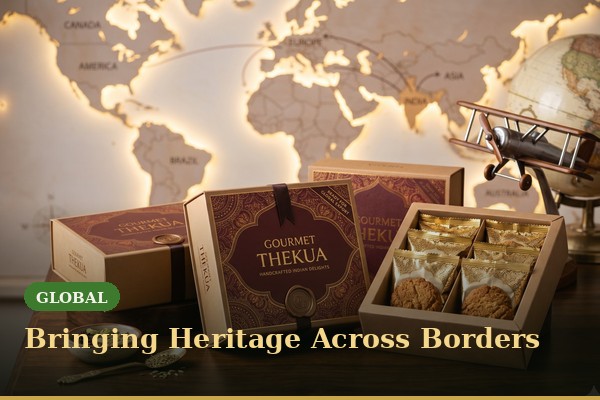
For the millions of Indians who live far from home, food is the most powerful bridge to a homeland that distance has made abstract. A single bite of a familiar snack can collapse thousands of miles and many years, returning an expatriate instantly to a grandmother's courtyard or a festival of childhood. This is why the global Indian diaspora hungers — sometimes literally — for authentic regional delicacies. And it is why bringing genuine Thekua across borders matters far beyond commerce.
The Emotional Weight of Diaspora Food
When you live in your home country, food is simply food — ever-present, taken for granted. When you emigrate, it becomes something else entirely: a lifeline to identity. NRI families across London, New Jersey, Toronto, and Sydney describe the peculiar ache of craving a specific regional snack that no local shop carries. Generic "Indian food" is everywhere abroad; authentic regional specialities like Bihari Thekua are rare to nonexistent.
For these families, finding a source of genuine Thekua is not a convenience — it is an emotional event. It means their children, born and raised abroad, can taste a piece of the heritage their parents carry. It means festivals like Chhath can be observed with the proper prasad even far from the Ganga. Food becomes the medium through which cultural continuity survives across generations and oceans.
The Logistical Challenge of Distance
Carrying a delicate, crunchy snack across continents is no small feat. The enemy is moisture and time — the very things that turn a crisp Thekua soft and stale. Solving this requires serious attention to packaging science. Multi-layered, vacuum-ready, food-grade barrier packs are designed to lock out moisture and oxygen, preserving the crunch profile through the long journey of international logistics.
This is where the absence of preservatives becomes a packaging challenge rather than a chemical one. Because authentic Thekua contains no synthetic shelf-life extenders, its freshness must be protected physically — through superior packaging and the snack's own naturally low moisture content. The result is a product that arrives in Manchester or Houston tasting as it did when it left the kitchen.
Authenticity as the Non-Negotiable
The diaspora market is uniquely unforgiving of inauthenticity. A casual local customer might not notice if a Thekua uses palm oil or refined flour. But an NRI grandmother who made this snack by hand for fifty years will know instantly if it is wrong — the texture, the aroma, the balance of sweetness. For this audience, cutting corners is fatal. The product must be genuinely, recognisably authentic, or it fails completely.
This demanding audience is, paradoxically, a gift. It enforces standards. A brand that satisfies the exacting palate of the diaspora has, by definition, kept faith with tradition. The zero-palm-oil policy, the pure desi ghee, the whole wheat, the real jaggery — these are not optional when your customer remembers exactly how it should taste.
Building the Global Bridge
Reaching the diaspora means meeting them where they shop — on global marketplaces like Amazon's international stores, where an NRI in California can order with the same ease as someone in Patna. It means transparent labelling that reassures a careful buyer. It means packaging robust enough for export logistics. Each of these is a strand in the bridge connecting an Indian kitchen to a kitchen halfway around the world.
More Than a Market
It would be easy to view the diaspora simply as a lucrative export opportunity. But that framing misses the deeper significance. Every package of authentic Thekua shipped abroad is a small act of cultural preservation across borders. It allows traditions to be observed, memories to be passed to children, and identities to be sustained in lands far from their origin.
A second-generation Indian-American child who grows up tasting real Thekua at Diwali maintains a thread of connection that might otherwise fray entirely. In that sense, exporting heritage food is a form of cultural diplomacy and continuity, conducted not through institutions but through taste and memory.
The Taste of Home, Anywhere
The promise is simple but profound: no matter how far you travel, the taste of home should be within reach. For the global Indian community, authentic Thekua delivered with its crunch and character intact is exactly that — a small, golden reminder that distance cannot sever the bonds of heritage. Wherever the diaspora settles, a piece of Bihar and Jharkhand can now settle alongside them, one carefully packed, lovingly made snack at a time.
The Generational Challenge of Diaspora Identity
For first-generation immigrants, connection to the homeland is direct and visceral — they remember its tastes, sounds, and rhythms. But for their children, born and raised abroad, that connection is mediated, partial, and at risk of fading entirely. This generational dilution of identity is one of the central challenges of diaspora life, and food plays a surprisingly powerful role in addressing it.
A second-generation child who grows up eating authentic regional foods at home maintains a sensory connection to a heritage they might otherwise know only abstractly. The taste of a grandmother's Thekua, even made far from home, becomes a thread linking that child to a culture they may never have experienced firsthand. Food carries identity across generations more effectively than almost any other medium, precisely because it operates through the deep, emotional channels of taste and memory.
The Failure of Generic Substitutes
The diaspora food market is full of generic, pan-Indian products that satisfy no one fully. A Punjabi misses authentic Punjabi food; a Bihari misses Bihari specialities; a South Indian misses regional dishes that no generic "Indian" brand bothers to make. The regional specificity that defines Indian cuisine is precisely what mass-market diaspora food erases. For someone craving the exact Thekua of their childhood, a generic "Indian sweet" is a poor and disappointing substitute.
This is why authentic regional products matter so much to the diaspora. They fill a gap that generic products cannot, offering not just "Indian food" but the specific taste of a specific home. The emotional payoff of finding a genuinely authentic regional speciality abroad is immense — it is the taste of home, exact and unmistakable.
The Engineering of Freshness Across Oceans
Delivering authentic crunch across thousands of miles is a serious technical undertaking. The journey from an Indian kitchen to a home in London or California involves weeks of transit, varying temperatures and humidity, and considerable handling. Each of these threatens the delicate crispness that defines good Thekua. Protecting it requires sophisticated packaging — multi-layered barrier films, vacuum or modified-atmosphere techniques, and moisture-absorbing measures that lock in freshness.
The absence of preservatives, while a health virtue, makes this engineering challenge harder. There are no chemical shortcuts to shelf life; freshness must be protected through physical means and the snack's own naturally low moisture content. When a Thekua arrives in a foreign kitchen still crunchy and aromatic after its long journey, that is the result of deliberate, careful packaging science working in service of authenticity.
Festivals Far From Home
For diaspora families, observing festivals takes on heightened emotional significance precisely because it requires effort. Celebrating Chhath or Diwali far from the homeland is an act of deliberate cultural maintenance. Having access to authentic prasad and festive foods makes these observances possible and meaningful. A family in New Jersey performing Chhath rituals needs proper Thekua just as much as a family in Patna — perhaps more, because for them it is also an act of preserving identity against the pressures of assimilation.
Supplying authentic festive food to the diaspora is thus a form of support for cultural continuity. It enables traditions to survive transplantation, allowing them to take root in new soil rather than withering from lack of essential ingredients.
Food as Cultural Diplomacy
There is a final, broader dimension to consider. When authentic Indian regional food reaches non-Indian neighbours, colleagues, and friends abroad, it becomes a form of cultural diplomacy. A curious American friend who tastes a genuine Thekua and loves it gains a small, positive connection to Indian culture. Multiplied across countless such encounters, authentic food becomes an ambassador, building goodwill and understanding in ways that formal diplomacy cannot. The humble Thekua, carried across borders with its integrity intact, thus serves a purpose far larger than itself — sustaining identity for the diaspora, and building bridges of understanding wherever it travels.