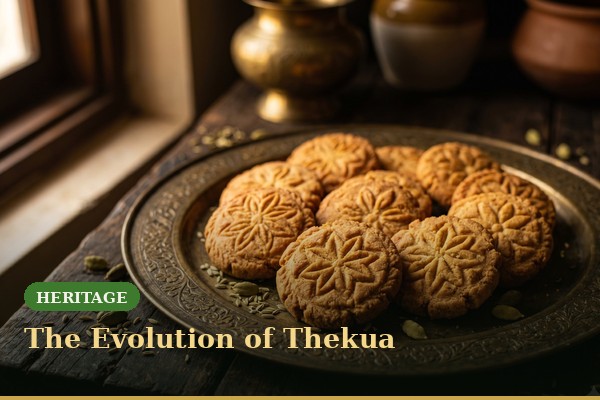
Long before the words "superfood" and "clean-label snacking" entered our vocabulary, the people of the Magadh region in Bihar and Jharkhand had already perfected a snack that ticked every box modern nutritionists now obsess over. That snack is Thekua — a dense, golden-brown disc of whole wheat flour, jaggery or sugar, and pure ghee, hand-pressed into ornate wooden moulds and baked or fried to a satisfying crunch. For centuries it has been the spiritual centrepiece of Chhath Puja, one of the oldest continuously observed Vedic festivals dedicated to the Sun God, Surya, and his consort Usha.
A Snack Born of Devotion
The story of Thekua does not begin in a factory or a test kitchen. It begins in the courtyards of riverside villages along the Ganga, where families fasted, prayed, and prepared offerings of absolute purity for the Chhath rituals. Thekua, known reverently as the "Maha-Prasad," was prepared under strict conditions of cleanliness — the kitchen scrubbed, the cook bathed and fasting, no tasting permitted during preparation. This was not mere cooking; it was an act of devotion. The ingredients were deliberately simple and shelf-stable: wheat for sustenance, jaggery for energy and iron, ghee for richness and preservation.
What makes this origin remarkable is that the very constraints of ritual purity produced a snack of extraordinary practicality. Because Thekua contained no water-heavy ingredients and no perishable dairy beyond clarified ghee, it could survive for weeks without refrigeration. A devotee could carry it on long pilgrimages; a traveller could tuck a few pieces into a cloth bundle for a multi-day journey. In a very real sense, Thekua was India's original energy bar — engineered by tradition, not by marketing departments.
The Science Hidden in Tradition
Modern food science has only recently caught up to what Magadhi grandmothers knew instinctively. Whole wheat flour delivers complex carbohydrates and dietary fibre, releasing energy slowly rather than in a sugar spike. Jaggery, unlike refined white sugar, retains trace minerals — iron, magnesium, potassium — stripped away during industrial refining. Ghee provides fat-soluble vitamins and a stable cooking medium with a high smoke point. Cardamom and fennel, the classic aromatics, aid digestion. Put together, Thekua is a balanced macronutrient package wrapped in heritage.
This is precisely why the snack endured across generations while countless trends came and went. It was never dependent on novelty. Its appeal was structural: it tasted of celebration, it travelled well, and it nourished the body. A food that satisfies all three of those demands rarely disappears.
From Village Courtyards to Urban Kitchens
As families from Bihar and Jharkhand migrated across India for work and education through the twentieth century, they carried Thekua with them. The festival of Chhath travelled too, and today you will find it celebrated on the banks of the Yamuna in Delhi, along Mumbai's beaches, and even in diaspora communities abroad. With every migration, Thekua found new audiences — neighbours who tasted it once and asked where they could buy more.
For a long time, the answer was: you couldn't. Thekua was strictly homemade, prepared once a year, shared but never sold. This scarcity only deepened its mystique. But it also meant that anyone outside the tradition who wanted to experience it had no reliable, hygienic, year-round source.
The Modern Reinvention
This is the gap that brands like ANORAA were created to fill. The challenge was delicate: how do you take a snack defined by ritual purity and homemade care, and produce it at scale without losing its soul? The answer lay in respecting the original recipe while upgrading the standards around it. That means sourcing whole wheat flour from trusted mills, insisting on pure desi ghee rather than cheap palm oil, refusing preservatives and artificial colours, and offering variants — fried for the traditionalist, baked for the health-conscious, gluten-free for those with dietary restrictions.
The result is a Thekua that an elderly relative from Patna would recognise as authentic, yet which meets the expectations of a label-reading urban professional in Bangalore or a health-focused parent in the United States. The crunch is the same. The aroma of cardamom and ghee is the same. What has changed is access: a snack once available only during one festival, in one region, prepared in one kitchen, can now reach a connoisseur anywhere in the world.
Why Heritage Matters in a World of Ultra-Processed Snacks
We live in an era of snacks engineered for addictiveness rather than nourishment — laden with refined flour, palm oil, synthetic flavours, and shelf-life chemicals. Against that backdrop, the return of a genuinely traditional snack is more than nostalgia. It is a quiet act of resistance. Choosing Thekua means choosing a recipe that was refined over centuries by people who could not afford to waste an ingredient or compromise on nourishment.
There is also a cultural dimension worth honouring. Every time someone outside Bihar tastes an authentic Thekua, a thread of Magadhi heritage is carried forward. Food is one of the most durable carriers of culture — more resilient than language, more portable than architecture. By bringing Thekua to the global stage with its integrity intact, we keep a piece of Vedic India alive in kitchens that have never heard of Chhath Puja.
The Road Ahead
The journey of Thekua from clay ovens to global shelves is far from complete. As more people discover it, the snack will inevitably be reinterpreted — paired with new flavours, packaged for new occasions, marketed to new audiences. The task for those who care about its heritage is to ensure that innovation never erases authenticity. A chocolate-dipped Thekua might sell well, but the classic jaggery version must always remain available, because that is the version that carries the story.
Thekua's evolution is, in the end, the story of India itself: ancient, adaptable, and endlessly generous. From a humble offering to the Sun God to a premium gourmet export, it has never stopped being what it always was — a small, golden reminder that the best food is the kind made with intention, patience, and love.
The Geography of a Recipe
To understand Thekua fully, you must understand the land that produced it. The Magadh region — encompassing parts of modern Bihar and Jharkhand — sits in the fertile Gangetic plain, one of the most agriculturally productive regions on earth. Wheat grows abundantly here, as does sugarcane, the source of jaggery. The recipe for Thekua is, in essence, a direct expression of local agriculture: it uses precisely what the land provides in greatest abundance. This is true of most enduring traditional foods. They are not invented in isolation; they emerge from the marriage of available ingredients and human ingenuity.
This agricultural logic also explains the snack's seasonal rhythm. Chhath Puja falls shortly after the major harvest, when fresh wheat and newly pressed jaggery are at their most plentiful. The festival, and its signature prasad, thus functions partly as a harvest celebration — a thanksgiving not only to the sun but to the earth that yielded the grain. Eating Thekua at Chhath is, at a deep level, eating the season itself.
The Wooden Moulds and Their Art
One of the most overlooked aspects of traditional Thekua is the carved wooden mould, or saancha, used to imprint patterns onto the dough. These moulds, often passed down through generations, carry intricate designs — floral motifs, geometric patterns, sometimes religious symbols. Pressing the dough into them is both functional and artistic, giving each Thekua its characteristic decorative face.
This detail matters because it reveals that Thekua was never merely sustenance. The effort to make it beautiful — to carve moulds, to imprint patterns — speaks to its ceremonial importance. Food prepared for the divine deserved to be beautiful. In an age of stamped, uniform factory biscuits, the handcrafted character of a properly made Thekua is a quiet rebellion, a reminder that food can carry artistry.
Thekua in the Modern Nutritional Conversation
As the world grapples with the consequences of ultra-processed diets, traditional foods like Thekua are being re-examined through a scientific lens. Researchers increasingly recognise that the dietary patterns of pre-industrial societies — built on whole grains, natural sweeteners, and traditional fats — often produced better metabolic health than the refined, additive-laden diets that replaced them. Thekua embodies these older patterns almost perfectly.
Consider its profile against a modern packaged biscuit. The biscuit typically contains refined flour, palm oil, refined sugar, synthetic emulsifiers, artificial flavour, and preservatives. The traditional Thekua contains whole wheat, ghee, jaggery, and spices. One is a product of food chemistry; the other is food. The fact that the older recipe is also the healthier one is not coincidental — it reflects the accumulated nutritional wisdom of generations who could not afford to eat badly.
Lessons for the Future of Food
The story of Thekua's journey to the global stage offers a template for how traditional foods can survive and thrive in the modern economy. The key is refusing the false choice between authenticity and accessibility. For too long, the assumption was that scaling a traditional food required compromising it — swapping ghee for palm oil, whole wheat for maida, natural sweeteners for refined sugar. Thekua's modern success proves otherwise.
By holding firm on ingredients while modernising standards of hygiene, packaging, and distribution, it is possible to take a food born in a village courtyard and deliver it, intact, to a kitchen on another continent. This is the future that conscious food brands are building — one where heritage is not a marketing veneer but a genuine, protected substance. Thekua leads the way, golden and unbroken, carrying its centuries of meaning into a new era.